#016
Kalguksu칼국수
Knife-cut Noodle Soup
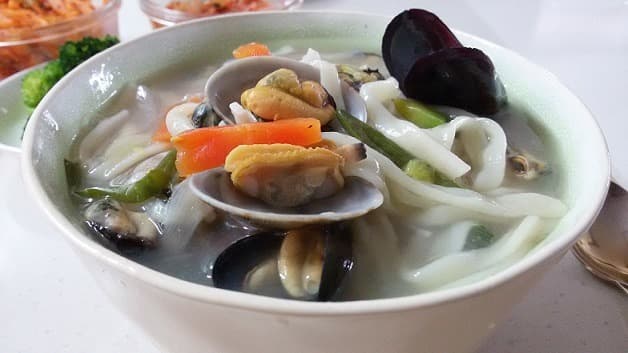
Hand-cut wheat noodles simmered in a light broth, often with clams or chicken.
History & stories
Kalguksu (칼국수) means "knife-cut noodles," and the name says it all. An early version appears as jeolmyeon ("cut noodles") in Gyugon Siuibang, a Joseon-era cookbook, but it was made mainly from buckwheat, with only a little wheat flour mixed in to hold the dough together. Wheat was scarce: the Goryeo-era record Gaoli Tujing notes that flour was so expensive people ate it only at weddings. In 1611 the scholar Heo Gyun, in his food memoir Domun Daejak, singled out the chasu, or knife-cut noodles, of Yeoju as a regional delicacy.
Wheat-flour kalguksu rolled thin and sliced shows up in modern cookbooks such as Ganpyeon Joseon Yori Jebeop (1934). Back then, though, the cooked noodles were rinsed in cold water and topped with a separately made clear broth, unlike today's version, where the noodles simmer right in the soup. Kalguksu became an everyday dish for ordinary people only after the Korean War, when wheat flour grew plentiful.
Daejeon, often called the city of kalguksu, has a reason for the nickname. Sitting where the Gyeongbu and Honam railway lines meet, it became a distribution point for aid wheat after the war, and passengers hopped off during stops at Daejeon Station for a quick bowl of kalguksu or udon-style noodles. According to a survey by the Daejeon Research Institute cited by the city, Daejeon had more than 700 kalguksu restaurants at the end of 2023, about five for every 10,000 residents, the highest rate among Korea's major metropolitan cities.