
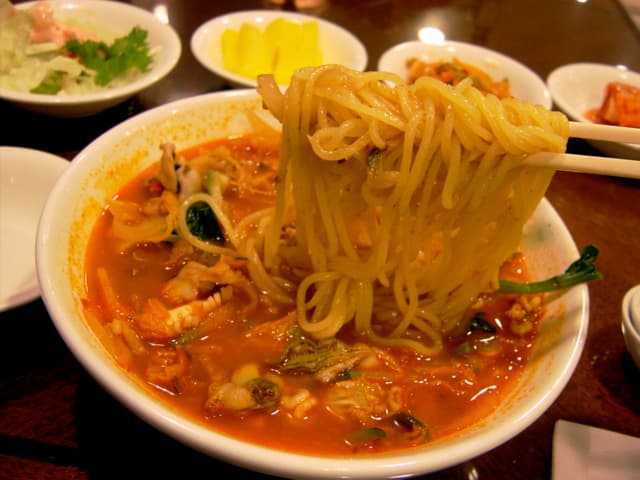
#015
Jjamppong짬뽕
Spicy Seafood Noodle Soup
A fiery red Korean-Chinese noodle soup loaded with seafood and vegetables.
History & stories
There are several theories about where jjamppong (짬뽕) came from. One holds that it began in the late 19th century with ethnic Chinese immigrants from Shandong living in Incheon, who adapted a Chinese noodle dish called chaomamian (炒碼麵) to Korean tastes by making it sweeter and spicier. They used vegetables and seafood that were easy to find, and the dish took the name jjamppong from a Japanese word meaning to mix many things together. That is also why jjamppong is sometimes called chomamyeon in Korean.
Another theory looks to Nagasaki, Japan. It is said that in the late 19th century, the owner of a Chinese restaurant there reworked tangrousimian (湯肉絲麵), a pork noodle soup, into a mild noodle dish to feed poor students from Fujian, and that the Japanese misheard the students' greeting as "champon," which became the dish's name. Either way, the name carries traces of people moving between Korea, China and Japan.
The fiery red jjamppong of today took shape in Korea. Red, spicy jjamppong became hugely popular through the 1970s, and the now-standard method spread: pork, dried chilies and chili flakes are stir-fried in oil, then seafood such as squid and shrimp and vegetables are added and simmered in stock. Jjamppong became one of the two signature dishes of Korean-Chinese restaurants alongside jjajangmyeon, and spin-offs such as oyster jjamppong and samseon (three-delicacy) jjamppong followed.