
#094
Dalgona달고나
Honeycomb Toffee
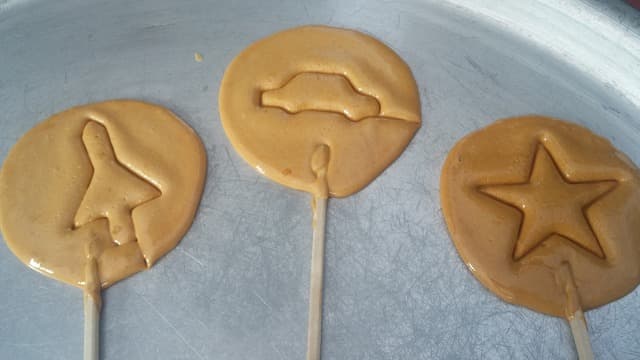
A crisp candy of melted sugar and baking soda, stamped with a shape to carve out.
History & stories
Dalgona (달고나) was the street-stall treat that kids crowded around outside school gates and in neighborhood alleys. Its exact beginnings are unknown. One story says it was first sold around Busan's port, where American aid supplies arrived during the Korean War, but this is not confirmed. Photos taken by an American soldier stationed in Daegu between 1953 and 1955 show a dalgona stall, so the candy was probably already familiar by the early 1950s. Sugar was a precious import until the 1950s; once production rose and prices fell in the 1960s, dalgona became a snack any child could buy.
Its name changed from region to region. In Seoul, Incheon and Gyeonggi it was dalgona or ppopgi, in Chungcheong and Jeolla it was ttigi, in Daegu and North Gyeongsang it was gukja ("ladle"), and in South Gyeongsang it was jjokja. The name dalgona is said to come from an exclamation meaning "sweeter than sugar!" People once drew a distinction: dalgona was a lump of glucose melted and eaten off a chopstick, while ppopgi was melted sugar pressed flat and stamped with a shape. The game of picking out the shape with a needle without breaking it, and winning another one if you succeeded, came from ppopgi.
After years as a nostalgic snack, dalgona went global in 2021 when the drama series Squid Game featured the shape-carving challenge. It was introduced abroad under the name dalgona, and making the candy at home and trying to carve out the shape became a social media trend.
