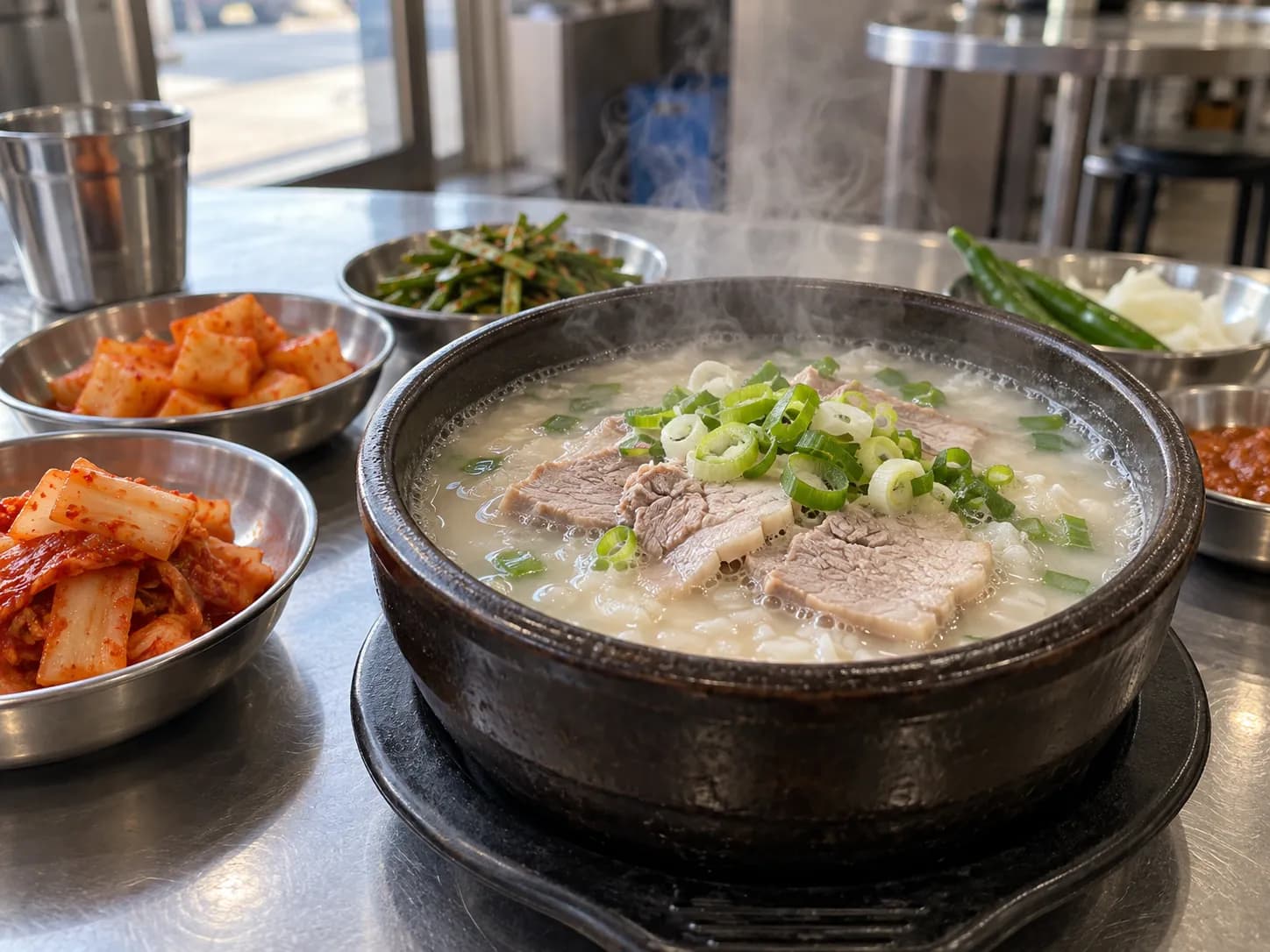

#028
Dwaeji-gukbap돼지국밥
Pork and Rice Soup
Busan's signature soup: rich pork broth and sliced pork, served with rice.
History & stories
No one can say exactly where dwaeji-gukbap (돼지국밥, pork and rice soup) began. One story traces it to a Goryeo-era king who handed out pork and other meat to his people, but the best-known theory points to the Korean War, when refugees made a seolleongtang-style soup from pork bones and offal because beef bones were hard to find. Some see it as a northern dish, like garigukbap, that took root in Gyeongsang Province through people from the North who fled to Busan and stayed. Tellingly, Seoul and the central regions have plenty of sundae-gukbap and beef-head soup but little dwaeji-gukbap, while it is everywhere in Busan, Miryang and Daegu.
In wartime Busan, crowded with refugees, the soup is said to have been made with pork and bones from U.S. military bases, and gukbap shops first thrived near the bases. A cheap, filling bowl of rice in rich pork-bone broth became everyday food for working people, and Busan is said to have more than 1,000 dwaeji-gukbap restaurants today.
Styles vary by region: Daegu-style goes heavy on spices and offal, Miryang-style has a milky broth like seolleongtang, and Busan-style a clearer one like gomtang. Many shops still practice toryeom, warming the rice and sliced pork in an earthenware bowl with hot broth. In 2026 Busan even held a citizens' vote to pick standout dwaeji-gukbap restaurants, a sign of how firmly the dish now belongs to the city.